Navigation
Diversions made simple
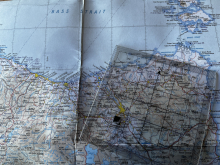
I love the challenge of navigating with a map, protractor, and scale rule. Navigating under VFR (Visual Flight Rules) isn’t about pinpoint perfection—it’s about making informed decisions quickly, refining them as you go, and staying ahead of the situation.Whether you’re following ATC instructions, dodging weather, or avoiding traffic, my goal is to set a new heading quickly using estimation with at least 95% accuracy. Whether making a slight course correction or executing a full-scale diversion, the key is getting established on a new heading quickly.
Modern tech like an iPad has its place, but it can demand too much of your attention upfront. Instead, layering traditional navigation techniques allows for a more adaptable and precise approach, and ultimately it's more engaging and interesting.
Step-by-Step Navigation Process
1. Set the New Heading
-
Follow ATC instructions if given, or use your best estimate based on cardinal compass directions.
-
Adjust your heading bug to match your new course.
-
Mark the time on your chart and flight log—essential for estimating arrival time and tracking progress.
2. Plot the New Track
-
Check your estimate using a protractor (don’t forget to adjust for magnetic variation!).
-
Account for wind drift to refine your heading.
-
Use your scale rule to determine your estimated time of arrival (ETA).
-
Compare your surroundings with your chart—what landmarks should be visible?
-
Incorporate additional tools like GPS, VOR, or an E6B flight computer as needed.
3. Monitor Your Position
-
Confirm your location using visual landmarks, GPS, or navigational aids.
-
Track elapsed time between key waypoints to detect any drift early.
-
Make small corrections rather than waiting for large course deviations.
4. Resuming Navigation
-
When conditions allow or ATC directs, return to your original course or continue with the diversion.
Getting Back on Track
Closing Angle Approach
-
Apply the 1-in-60 rule to calculate a correction angle that gets you back on course smoothly.
Returning to the Original Track
-
If the deviation was short, a simple realignment might be all that’s needed.
-
Mirror the deviation: If you drifted left by 10 degrees for five minutes, fly 10 degrees right for five minutes to regain track.
-
For longer deviations, calculate a direct-to interception or use a gradual rejoin technique.
Final Verification & Checks
Before settling back into cruise mode, run your CLEAROFF checks:
-
Compass – Confirm you're on the correct heading and your location.
-
Log – Log your position on the chart.
-
Engine – Pressures and temperatures and lean as required
-
Altitude – Maintain or adjust as needed.
-
Radio – Check frequency.
-
Orientation – Look ahead for terrain or airspace restrictions.
-
Fuel – Check consumption and endurance.
-
Failure – What options are available
Conclusion
This structured method keeps navigation quick, accurate, and manageable, ensuring you stay ahead of the aircraft rather than reacting to it. By blending estimation, verification, and refinement, you can enjoy diversions in flight.