Flying (like a kayak)
I'm sure there are pilots out there who also enjoy kayaking or canoeing. The similarities between the behavior of an aircraft and a kayak may feel familiar—both 'craft' interact with their dynamic environment in fluid, ever-changing ways.
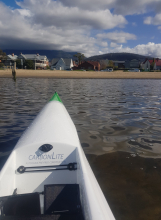
I enjoy paddling a kayak designed by Valley kayaks and a surf ski (shown below). If my kayak underwent a metamorphosis into an aircraft, it might be a Cirrus SR22. Like the aircraft my kayak is sleek and streamlined; unlike the aircraft, the kayak is economical to buy and cheap to run.
The kayak was designed with the intention of crossing the English Channel in as fast as possible time, although mine isn't put to such extreme tests. More typically it is taken on outings on the River Derwent in Hobart. Hobart is windy though, having this in common with the English Channel.
A kayak, as with an aircraft, likes going into the wind. In these conditions, the somewhat twitchy hull feels balanced and paddling is a pleasure. Once the wind is on the beam it is a different story though, and the kayak will always prefer to point into the wind (weathervaning is the tendency to turn into the wind). For an interesting explanation on kayak weathervaning, there is this article in Superior Paddling. Weathervaning is due to the different effects of abeam winds on bow and stern pressure zones. In an aircraft, the tailplane is probably the greater contributor to the turning force into the wind.
Similarly to crosswind landings, a kayaker can roll their craft into the wind to reduce the surface area exposed to crosswinds. The roll also creates a secondary yaw effect. The yaw happens due to the change of the shape of the kayak (or aircraft) exposed to the flow of water (or flow of air). A slight roll in a kayak or surf ski produces a bank or turn: roll to the right and the kayak turns to the left (adverse yaw in an aircraft is if the aircraft is banking to the right, the right wing goes down, and the left wing goes up. The left wing's increased drag causes the nose to yaw to the left, opposite to the intended right turn.)
My kayak, with its small rudder, has a practical crosswind limit, much like an aircraft’s tailplane defines its functional crosswind limit. The other paddling technique is to zigzag to your destination by alternately changing your direction by about 45 degrees into wind and then towards downwind.
Some surf skis and kayaks have a fixed skeg combined with a rudder. This is similar to the aircraft design of a fixed tailplane and a rudder. The variety of adaptations in kayaks to yaw stability is extensive, including skegs with no rudder, retractable skegs and retractable rudders. The other method the paddler can use to control movement into the wind is through changing the paddle motion, such as by using a sweep stroke on the opposite (downwind) side.
Next time you're out on the water or up in the air, pay attention to the delicate dance between you and the wind. Whether you're a paddler or a pilot, mastering these lateral forces can make all the difference. If you are paddling, you can be thinking just like a pilot.
(You can view a video of me paddling in the Valley kayak at https://www.youtube.com/watch?v=eeh_pBKvv0E&t=24s)